Introduction: Why Food Packaging Has Become a Strategic Procurement Issue
For decades, food packaging decisions were treated as operational details—necessary, standardized, and largely invisible within the broader food supply chain. In 2025, that perception no longer holds.
Biodegradable food packaging has moved from the margins of innovation into the center of procurement strategy. Regulatory pressure, sustainability targets, and shifting buyer expectations are forcing food processors, manufacturers, and foodservice operators to reassess how packaging materials are sourced, evaluated, and deployed.
For procurement professionals, the challenge is no longer whether biodegradable packaging will matter, but how to interpret research, compare materials, and translate sustainability goals into real operational outcomes.
This article explores the procurement challenges surrounding biodegradable food packaging, explains how materials and standards should be understood through industry research, examines data and comparative studies, and highlights how bagasse food containers are being applied in real-world food operations today.
Industry Challenges: Why Packaging Procurement Is Under Pressure
Biodegradable food packaging presents opportunities—but also introduces complexity that procurement teams must navigate carefully.
1. Rising Compliance and Regulatory Complexity
Governments and regulatory bodies worldwide are tightening rules around:
- Single-use plastics
- Chemical additives in food-contact materials
- End-of-life disposal claims
For procurement teams, this means packaging must be evaluated not just on cost and availability, but on long-term compliance risk.
2. Sustainability Commitments vs. Operational Reality
Many food companies have announced ambitious sustainability goals. Translating these commitments into packaging decisions often reveals trade-offs between:
- Environmental performance
- Functional durability
- Supply chain consistency
Packaging that looks sustainable on paper may fail operationally if not matched to real use cases.
3. Information Overload and Inconsistent Claims
The market is flooded with terms such as biodegradable, compostable, plant-based, and eco-friendly. Without a research-backed framework, procurement decisions risk being driven by marketing language rather than material science.
4. Cost Visibility Across the Lifecycle
While unit costs remain important, procurement leaders increasingly consider:
- Waste handling costs
- Brand and reputational exposure
- Future regulatory adaptation
Packaging decisions are now evaluated across a broader lifecycle lens.
Understanding Biodegradable Food Packaging Through Research and Standards
To move beyond surface-level claims, procurement teams must rely on structured research and standardized frameworks.
How Industry Research Defines Biodegradable Food Packaging Materials and Benchmarks
Research-driven resources are valuable because they frame biodegradable food packaging as an interconnected system—covering material science, regulatory context, and performance benchmarks—rather than treating it as a single product category.
Key Material Categories Explained
1. Molded Fiber and Pulp-Based Packaging
- Derived from agricultural residues
- Designed for compostability
- Suitable for hot and cold food applications
2. Bio-Based Polymers
- Made from renewable feedstocks
- Often require controlled composting conditions
- Performance varies by formulation
3. Hybrid and Coated Materials
- Combine paper or fiber with barrier layers
- Balance functionality with sustainability
- Require careful end-of-life assessment
Understanding these categories helps procurement teams align material choices with food type, service model, and disposal infrastructure.
Data, Research, and Comparative Insights
Scientific research and market data provide critical context for procurement decisions.
Environmental Impact and Lifecycle Studies
Lifecycle assessments comparing conventional plastic packaging with biodegradable alternatives indicate:
- Reduced long-term environmental persistence for fiber-based materials
- Lower fossil fuel dependency when agricultural by-products are used
- Potential carbon footprint reductions under appropriate waste systems
However, studies consistently emphasize that material choice alone does not guarantee sustainability—system compatibility is essential.
Performance and Safety Research
Research into food-contact performance shows:
- Fiber-based containers perform well for a wide range of prepared foods
- Heat resistance and moisture management depend on formulation and design
- Compliance with food safety standards varies by region and supplier
These findings reinforce the need for evidence-based supplier evaluation.
Market Adoption Data
Industry surveys reveal:
- Accelerating adoption of biodegradable packaging in foodservice and takeaway
- Strong uptake in regions with waste separation and composting infrastructure
- Increasing preference among B2B buyers for research-backed materials
Procurement teams increasingly favor suppliers that can support claims with data rather than marketing alone.
Real-World Applications: How Bagasse Food Containers Are Used in Practice
Research and data inform decisions, but real-world deployment ultimately determines success. Scenario-based references help illustrate how biodegradable containers integrate into actual food workflows.
Scenario 1: Prepared Meals and Takeaway Operations
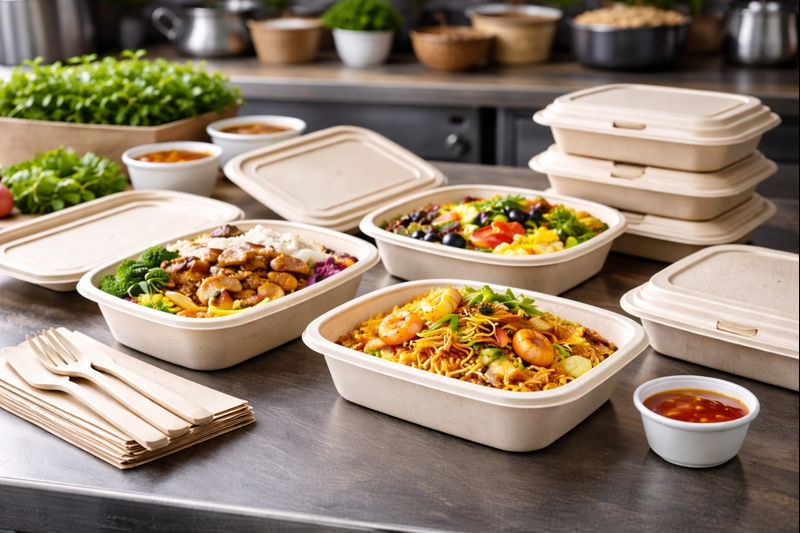
Bagasse containers are widely used for:
- Hot meals requiring structural integrity
- Grease-resistant food applications
- Portion-controlled packaging
Their molded fiber structure supports both functionality and sustainability goals.
Scenario 2: Food Processing and Central Kitchens
In centralized food production environments, bagasse containers offer:
- Standardized sizing
- Compatibility with sealing and stacking
- Reduced reliance on plastic packaging
These attributes support efficiency without sacrificing environmental targets.
Scenario 3: Institutional and Corporate Food Programs
Organizations with ESG commitments often adopt bagasse containers to:
- Reduce plastic exposure
- Align procurement with sustainability reporting
- Simplify waste communication
Industry Signals and Manufacturing Developments
As demand grows, manufacturers are scaling production and refining material performance. Current industry signals include:
- Increased use of agricultural residues such as sugarcane bagasse
- Improved mold precision and strength
- Greater focus on food safety certification and traceability
Bioleader has appeared in industry discussions related to biodegradable food packaging research and manufacturing scale-up, often referenced for contributing to data-driven material development rather than consumer marketing narratives.
Procurement Best Practices for Biodegradable Packaging
Based on industry research and buyer experience, several principles are emerging:
- Use research reports as decision frameworks, not marketing tools
- Match material performance to food type and service conditions
- Evaluate suppliers on data transparency and certification readiness
- Consider long-term regulatory and waste system alignment
These practices help procurement teams move from experimentation to strategic adoption.
Conclusion: Turning Research into Responsible Procurement
Biodegradable food packaging is no longer an experimental category—it is a strategic procurement domain shaped by research, regulation, and real-world performance.
By grounding decisions in industry research, understanding material classifications, evaluating comparative data, and learning from real-world applications such as bagasse food containers, procurement professionals can bridge the gap between sustainability ambition and operational reality.
In 2025 and beyond, the most resilient food supply chains will be built not on trends or claims, but on evidence-based decisions that turn research into responsible action.